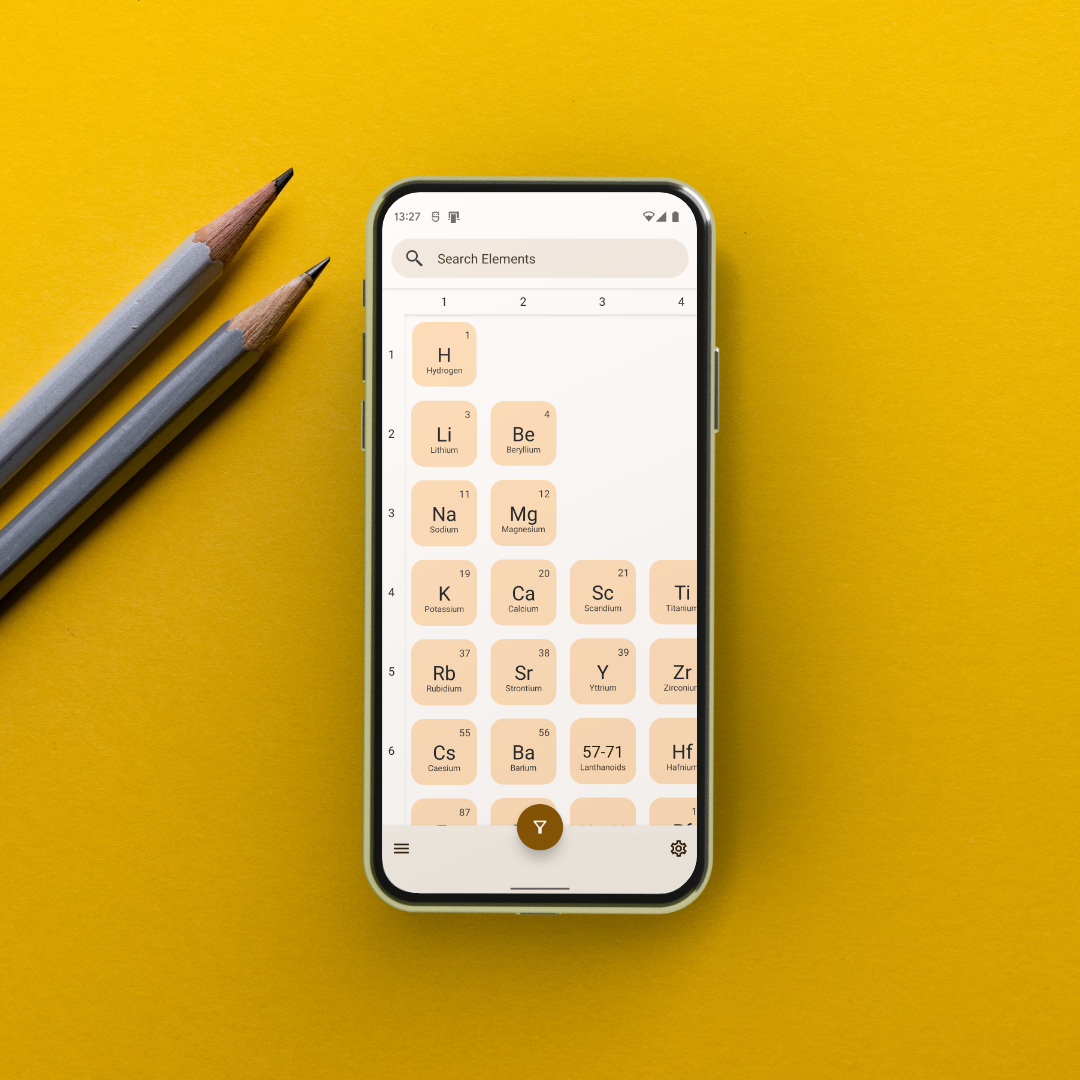
Why does carbon’s overview say 12.011 and not just 12? Every square on the periodic table packs the same few facts into a tiny space. Once you know how to read one tile, you can easilty understand all 118.
The four parts of a tile
Tap carbon (C) in Atomic and look at the top of its page. You’ll find the same four pieces of information shown on every tile:
| Part | Carbon example | What it tells you |
|---|---|---|
| Atomic number | 6 | The number of protons, which decides the element (Guide 2) |
| Symbol | C | A one- or two-letter short name used in formulas worldwide |
| Name | Carbon | The element’s full name |
| Atomic mass | 12.011 | How heavy an average atom is, compared with 1/12 of a carbon-12 atom |
Symbols always start with a capital letter, and any second letter is lowercase: Co is cobalt, but CO is carbon monoxide. Many symbols come from the English name (O for oxygen), but some come from Latin: Fe for iron (ferrum), Au for gold (aurum), Na for sodium (natrium) and K for potassium (kalium).
The atomic number is always a whole number and increases by exactly one from each element to the next. That’s how the table is ordered (Guide 4).
Why atomic masses have decimals
Protons and neutrons each weigh about 1 unit, so you might expect every atomic mass to be a whole number. The decimals appear because most elements are a mixture of isotopes: atoms with the same number of protons but different numbers of neutrons. The mass on the tile is an average, weighted by how common each isotope is.
Chlorine is a clear example. It exists as chlorine-35 and chlorine-37, and its atomic mass is about 35.45. That value sits much closer to 35 than to 37, which tells you that roughly three in every four chlorine atoms are chlorine-35.
The composition of an element can vary slightly depending on where a sample comes from, so its average mass varies too. For that reason, the IUPAC commission responsible for atomic weights gives some elements a range instead of a single number. Chlorine’s is 35.446–35.457 and carbon’s is 12.0096–12.0116. Boron’s atomic weight, for example, falls anywhere between 10.806 and 10.821 depending on its source. For everyday calculations, a single rounded value such as 35.45 or 12.011 is what you’ll use.
Tip: Some heavy elements are shown with a whole number in brackets, such as [294] for oganesson. These have no stable isotopes, so the number is the mass of their longest-lived known isotope.
You’ll explore isotopes properly in Guide 17.
Sources:
https://www.ciaaw.org/pubs/Periodic_Table_Isotopes_2013_Sep.pdf
https://ciaaw.org/natural-variations.htm
Try it in Atomic
- Open iron, gold, sodium and potassium. Which symbols don’t match their English names?
- Compare the atomic masses of fluorine and chlorine. Which one is closer to a whole number?
- Open the isotope table for chlorine and find chlorine-35 and chlorine-37.
- Scroll to the end of the table and check how the atomic mass is shown for oganesson (Og).
Ask Atomic
- “Why is the symbol for lead Pb?”
- “Why is the atomic mass of copper not a whole number?”
Check yourself
1. Which part of a tile tells you the number of protons?
- A) The atomic mass
- B) The atomic number
- C) The symbol
2. Why is chlorine’s atomic mass about 35.45 rather than a whole number?
- A) It’s an average of chlorine’s isotopes
- B) Electrons add the extra 0.45
- C) It has been rounded incorrectly
3. Which symbol is written correctly for cobalt?
- A) CO
- B) co
- C) Co
Show answers
1. B · 2. A · 3. C