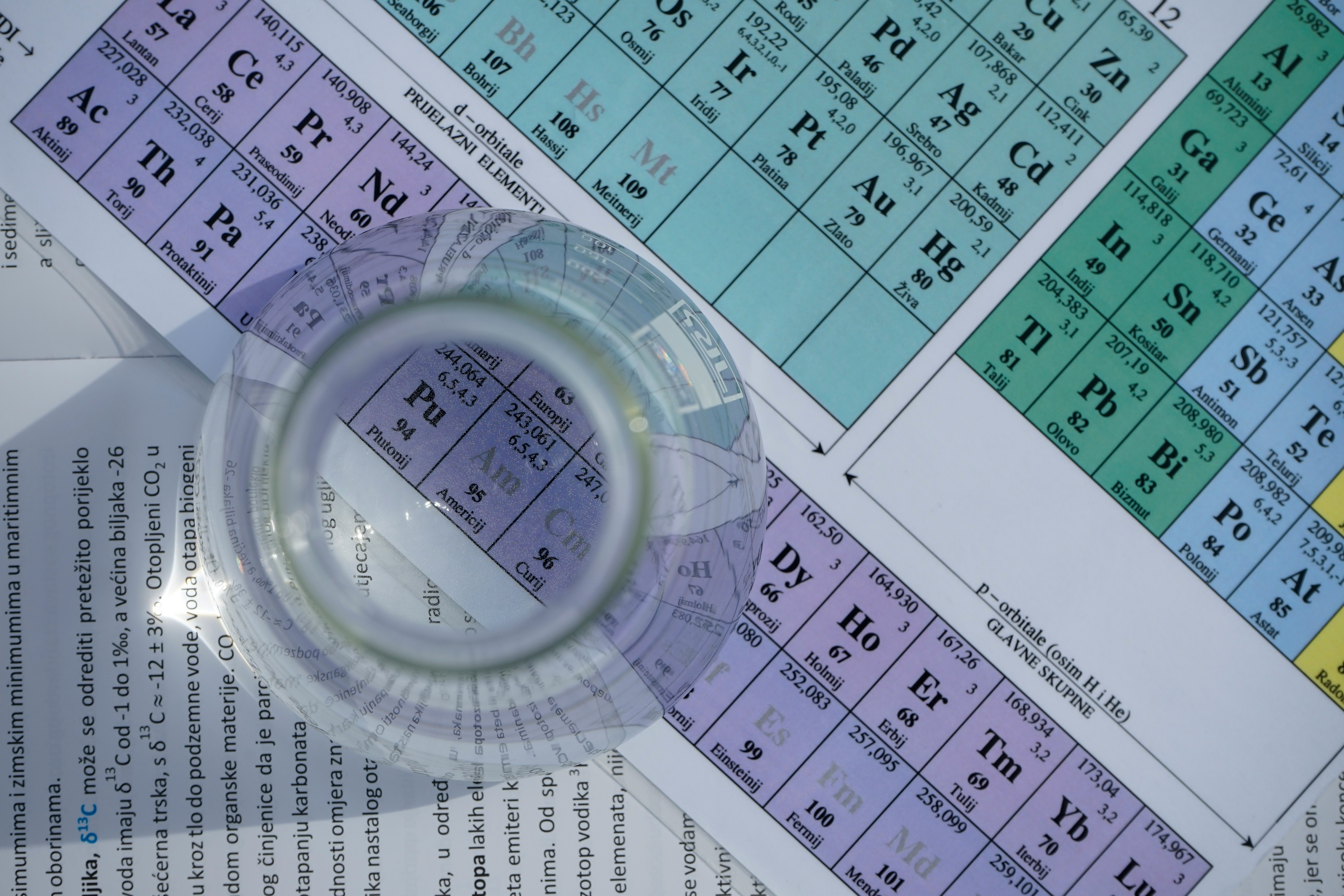
Everything you breathe or touch have one thing in common. They are all built from elements, the basic ingredients of everything around you. This guide will give you an overview of what an element actually is and why a single number decided which one you’re looking at!
Inside an atom
Everything is made out of atoms, and every atom is built out of three kinds of particles:
| Particle | Charge | Mass (compared with a proton) | Where it is |
|---|---|---|---|
| Proton | +1 | 1 | In the nucleus, at the centre |
| Neutron | 0 | About 1 | In the nucleus |
| Electron | −1 | About 1/1836 | Around the nucleus |
The core of every atom is a nucleus, which holds almost all of the atom’s mass. This atomic nuclei consists of electrically positive protons and electrically neutral neutrons. The nucleus makes up less than .01% of the volume of the atom, but contains more than 99.9% of the mass.
Source:
https://www.energy.gov/science/doe-explainsnuclei
One number decides the element
What matters is how many protons are in the nucleus. That count is called the atomic number, written as Z. The International Union of Pure and Applied Chemistry (IUPAC), defines an element as all atomis with the same number of protons in the nucleus.
Examples:
- 1 proton → always hydrogen
- 6 protons → always carbon
- 79 protons → always gold
If the number of protons is changed, the element will be a different one. However, changing other particles still results in the same element, bu ast:
- Electrons – gain or lose some and you get an ion, a charged atom (Guide 11).
- Neutrons – gain or lose some and you get an isotope. Carbon-12 and carbon-14 are both carbon (Guide 17).
The word “element” also gets used for pure substances, such as e.g. a lump of gold. However, IUPAC notes that the substance is strictly called an elementary substance, but in everyday chemistry both meanings are called an element.
Source:
https://goldbook.iupac.org/terms/view/C01022
How many elements are there?
There are 118 known elements, numbered 1 (hydrogen) to 118 (oganesson). The last four, nihonium (113), moscovium (115), tennessine (117) and oganesson (118), received their official names from IUPAC on 28 November 2016, which completed the periodic table’s seventh row.
Where do the elements come from?
Almost all of the hydrogen and helium in the universe formed in the first minutes after the Big Bang. However, heavier elements were forged later. Stars fuse lighter nuclei into elements up to iron and exploding stars (supernova) created the elements that are heavier than iron. E.g. the carbon in your body and the iron in your blood were once made inside a star.
Source:
https://iupac.org/iupac-announces-the-names-of-the-elements-113-115-117-and-118/
https://www.scholastic.com/nasawebb/pdfs/StarPowerReadingPassage.pdf
Try it in Atomic
- Tap hydrogen (H), then helium (He), then lithium (Li). Watch the atomic number rise by one each time: one more proton.
- Open gold (Au) and find its atomic number. How many protons, and how many electrons in a neutral gold atom?
- Scroll to the bottom-right corner of the table and open oganesson (Og), element 118.
- Open the isotope table and look up carbon. Every row has 6 protons; only the neutrons change.
Check yourself
1. What decides which element an atom is?
- A) The number of neutrons
- B) The number of protons
- C) The number of electrons
2. An atom has 8 protons, 8 neutrons and 10 electrons. What is it?
- A) An oxygen ion
- B) A neon atom
- C) An oxygen isotope
3. Where were most elements heavier than iron made?
- A) In the Big Bang
- B) In ordinary stars like the Sun
- C) In supernova
Show answers
1. B · 2. A · 3. C