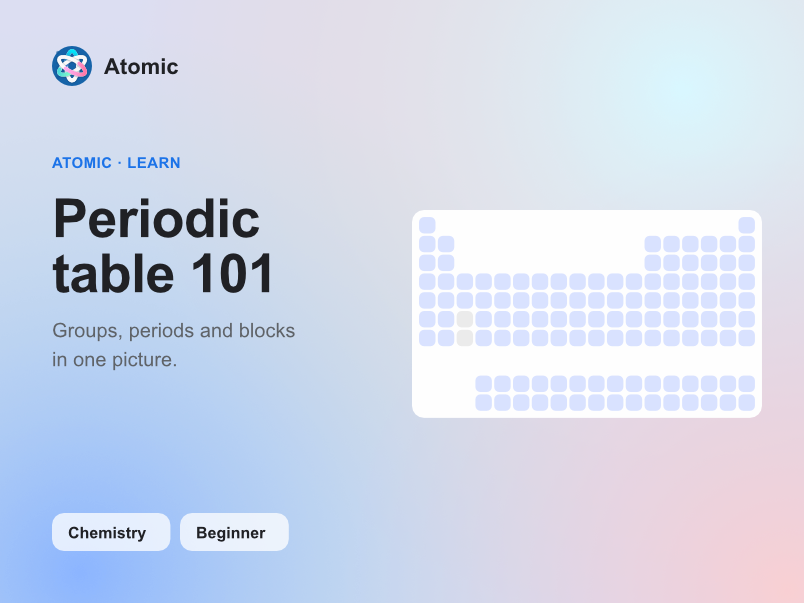
The periodic table is a map of all 118 known elements, and its layout tells you much about each element before you even read any facts about it. Rows are called periods, columns are called groups, and the table splits into four blocks named s, p, d and f.
Throughout this guide you will learn to look at any element in the periodic table and tell three main things about it: how many electron shells it has, roughly how many electrons it uses to react and which family it belongs to.
Starting with one tile
Every square in the table holds the same four facts: atomic number, symbol, name and atomic mass. Take for example iron:

| On the tile | Iron | What it means |
|---|---|---|
| Atomic number | 26 | The number of protons in the nucleus. It defines the element and sets its place in the table. |
| Symbol | Fe | A one- or two-letter short name, often from Latin (ferrum). |
| Name | Iron | The everyday name. |
| Atomic mass | 55.845 | The average mass of one atom, in atomic mass units. |
The table is ordered by atomic numbers, read left to right and top to bottom with each element having exactly one more proton than the previous element. Hydrogen is 1, helium is 2, lithium is 3 and so on up to oganesson at 118.
Tip: In a neutral atom the number of electrons equals the atomic number. Iron has 26 protons, so it also has 26 electrons. That is the key to everything below.
Periods: the rows
The period number tells you how many electron shells and atom has. There are seven periods, so the largest atoms use seven shells.
- Sodium (Na) sits in period 3. Its electrons fill three shells: 2 · 8 · 1.
- Iron (Fe) sits in period 4. Its electrons fill four shells: 2 · 8 · 14 · 2.

Moving one step right along a period adds one proton and one electron. The new electron usually joins the outermost shell. When that shell is full, the periods ends with a noble gas and the next period starts a new shell.
The periods are not all the same lengths, as outer shells needs to have room for more electrons. For the first period, it only has place for 2 electrons and thereby only consists of 2 elements.
| Period | Elements | Runs from → to |
|---|---|---|
| 1 | 2 | Hydrogen → Helium |
| 2 | 8 | Lithium → Neon |
| 3 | 8 | Sodium → Argon |
| 4 | 18 | Potassium → Krypton |
| 5 | 18 | Rubidium → Xenon |
| 6 | 32 | Caesium → Radon |
| 7 | 32 | Francium → Oganesson |

Remember: Same period = same number of shells. Behaviour changes a lot as you move along a row.
Groups: the columns
Element in the same group behave alike, as they have the same amount of electrons in their outer shell. These outer electrons are named valence electrons, and they are the ones an atom uses when it reacts. The table has 18 groups, number 1 to 18 from left to right in the periodic table.
For the tall columns at the edges (groups 1,2 and 13-18), the group number tells you the valence electrons directly.
- Groups 1 and 2: the valence electrons equal the group number (sodium in group 1 has 1).
- Groups 13 to 18: subtract 10 (oxygen in group 16 has 6, neon in group 18 has 8).
- Helium is the exception: it sits in group 18 but has only 2 electrons, which already fill its single shell.
Several groups have family names you will meet again and again:
| Group | Family | Valence electrons | What they are like |
|---|---|---|---|
| 1 | Alkali metals | 1 | Soft, very reactive metals that give away their one electron. Sodium and potassium react violently with water. |
| 2 | Alkaline earth metals | 2 | Reactive metals, a bit calmer than group 1. Calcium is in your bones. |
| 3–12 | Transition metals | varies | Hard, shiny metals such as iron, copper and gold. Many form coloured compounds. |
| 17 | Halogens | 7 | Reactive non-metals one electron short of a full shell. Chlorine and fluorine grab electrons eagerly. |
| 18 | Noble gases | 8 (helium 2) | Full outer shell, so they barely react. Neon and argon light up signs and bulbs. |

Hydrogen is the odd one out as it sits at the top of group 1 because it has one electron, but is a gas and a non-metal, not an alkali metal.
Fun fact: In Atomic each family has its own colour: alkali metals are red, alkaline earth metals are amber, transition metals are rose and noble gases are teal. Once you know the colours, you can read a family at a glance. In ‘Atomic – Periodic Table’ these can be seen by toggling a filter for categories.
Blocks: s, p, d and f
The table is also split into four blocks, named after the kind of orbital that the outermost electrons are filling. An orbital is a region around the nucleus where an electron is likely to be found, and each kind holds a set number of electrons.

The width of each block is no accident: it matches how many electrons that kind of orbital can hold.
| Block | Columns | Orbitals hold | Where |
|---|---|---|---|
| s | 2 | 2 electrons | Groups 1–2, plus helium |
| p | 6 | 6 electrons | Groups 13–18 |
| d | 10 | 10 electrons | Groups 3–12 |
| f | 14 | 14 electrons | The two rows at the bottom |
Why do two rows sit below the table? The f-block belongs in periods 6 and 7, between groups 2 and 3. Putting it in place would make the table 32 columns wide, so it is lifted out and printed underneath. The empty cells in group 3 mark where it slots in.
Helium again. By its electrons, helium belongs to the s-block, next to hydrogen. It is placed above the noble gases because it behaves like one.
Fun fact: The letters come from old descriptions of lines in light spectra: sharp, principal, diffuse and fundamental.
Putting it togheter
Periods, groups and blocks combine into a few patterns that hold across the whole table.
Metals on the left, non-metals on the right. Most elements are metals: the s-, d- and f-blocks and the lower part of the p-block. Non-metals gather in the top right. Between them runs a staircase of metalloids (boron, silicon, germanium, arsenic, antimony, tellurium), which behave partly like each.
Trends across and down. Moving right along a period adds protons while the number of shells stays the same, so the nucleus pulls the electrons in tighter. Moving down a group adds a whole shell, so atoms get bigger and the outer electrons sit further away.
| Property | Left → right across a period | Top → bottom down a group |
|---|---|---|
| Atomic radius (size) | Gets smaller | Gets bigger |
| Ionisation energy (energy to remove an electron) | Rises | Falls |
| Electronegativity (pull on shared electrons) | Rises | Falls |
| Metallic character | Falls | Rises |

That is why the most reactive metals (caesium, francium) sit bottom left, and the strongest electron-grabber, fluorine, sits top right.
Careful: Trends describe the general direction. Neighbouring elements sometimes break them by a small amount, and the noble gases are usually left out of electronegativity.
Check yourself
Check yourself
1. Selenium has atomic number 34 and four electron shells. Which period is it in?
- A) Period 3
- B) Period 4
- C) Period 16
2. Oxygen is in group 16. How many valence electrons does it have?
- A) 16
- B) 8
- C) 6
3. Which block is uranium in?
- A) The d-block
- B) The f-block
- C) The p-block
4. Sodium and chlorine are both in period 3. Which atom is bigger?
- A) Sodium
- B) Chlorine
- C) They are the same size
5. Why do noble gases hardly react?
- A) Their outer shell is already full
- B) They have no electrons
- C) They are metals
Show answers
1. B · 2. C · 3. B · 4. A · 5. A