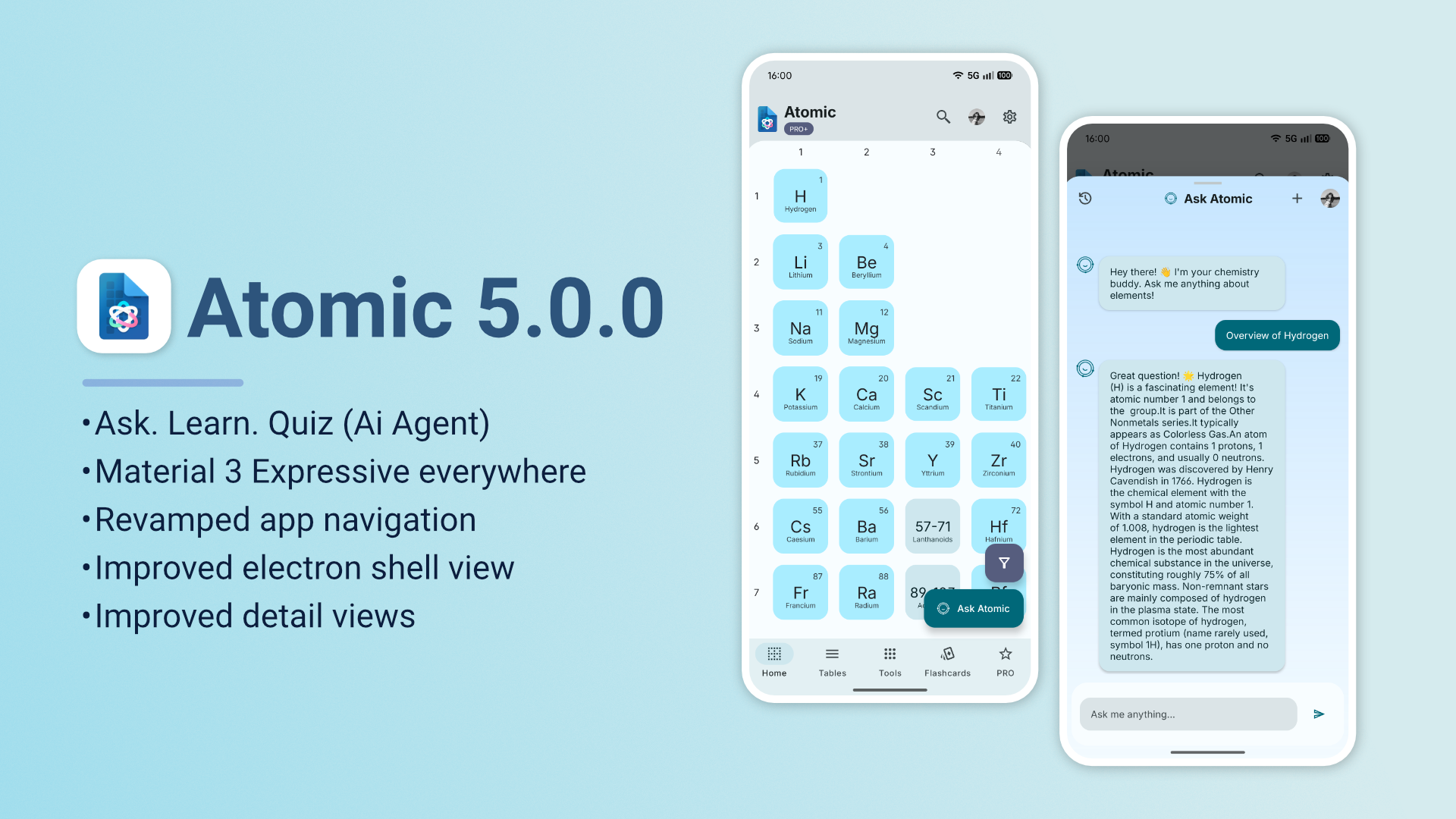
Atomic started as a simple idea: a periodic table that is fast, beautiful, and gets out of your way. Over 100,000 downloads later, it has grown into a full chemistry reference used by students, teachers, and working chemists.
Version 5.0.0 is the biggest release so far. It adds something the periodic table alone could never do, the ability to ask for faster learning.
The AI assistant
A chat panel that answers chemistry questions in plain language. It slides up from the bottom of the periodic table screen and is available on every element page.
It runs entirely on your device. There is no language model, no API key, and no network request in the answer path. The assistant parses your question, looks the answer up in the element data installed with the app, and composes a response. Two consequences follow: it works in airplane mode, and your questions never leave the phone.
- Structured query engine: questions are tokenised, resolved to entities and fields, scanned for operators, planned into a typed query, executed against a typed knowledge store, and composed into an answer. Every number in a reply traces back to a specific field of a specific element.
- Lexical retrieval fallback: Over roughly 780 documents, indexed at runtime from live app data and fused with exact entity matching in
HybridRetriever. - It declines rather than guessing. Questions the data cannot support get an honest refusal instead of a plausible-sounding invention.
Question Types Supported:
| Category | Example |
|---|---|
| Property lookup | density of tungsten |
| Unit conversion in the question | melting point of iron in Fahrenheit |
| Comparison | is gold denser than lead |
| Superlatives | which element has the highest melting point |
| Filtered lists | transition metals with density above 15 |
| Aggregates | average atomic mass of the halogens |
| Isotopes and nuclides | how many neutrons in carbon-14 |
| Formulas and moles | how many moles in 25 g of NaCl |
| Reference data | what is the Planck constant |
| Compound questions | density of gold and how does it compare to lead |
| Follow-ups | and its boiling point? |
Supporting features:
- Eight answer card types, selected only when the underlying data supports one: electron shell diagram, crystal structure, ionisation series, isotope decay chart, abundance bars, NFPA diamond, Poisson band, emission spectrum.
- Deep-link chips on answers that jump into the constants table, the nuclide chart, or the relevant element page.
- Twelve languages, detected per message with no setting to change.
- Element context: opening the assistant from an element page carries that element into the conversation, so follow-ups resolve without naming it again.
- Daily message limits: 16 free, 64 on PRO, unlimited on PRO+, keyed to the device’s calendar day and reset at local midnight.
- Chat history: in memory when signed out; the last 20 sessions saved to your account and restored on any device when signed in.
Learning games updates
The flashcard games have been greatly improved with additional games and an exam mode.
- Exam mode: a fixed-length assessment run rather than open-ended practice.
Home-screen widgets
Three new widgets join the existing two, for five in total. All adopt Material You dynamic colour on Android 12 and later, follow the app’s light/dark setting, and display in your chosen language.
| Widget | What it does |
|---|---|
| Science Daily (new) | A random chemistry fact, auto-sized to the widget |
| Quick Ask (new) | A pill-shaped bar that opens the assistant directly |
| Quick Nav (new) | Four tiles: Table, Quiz, AI, Molar mass |
| Element of the Day | One element per day, rotating by day of year |
| Search | Opens the app to search |
Reference tables and tools
- Alloys table (PRO): common alloys with constituent elements and proportions.
- Solubility table: New improved material 3 expressive design
- Every reference table is indexed by the assistant, so its contents can be reached by asking as well as by browsing.
General
- The app shell was restructured into a five-tab bottom navigation: Table, Tables, Tools, Learn, PRO — with each tab a fragment on a shared base. The main activity was rewritten around this.
- Unified title bar across screens, driven by a single controller.
- Tables and Tools lists are drag-reorderable, with your order persisted and a “most used” chip row at the top of each.
- The reference table list grew to twelve entries and the tools list to four, with the chemical reaction balancer reachable but unlisted.
- PRO fields now render as a locked card with an upgrade prompt rather than being hidden, so it is clear what a tier unlocks.
- The ideal gas calculator is now free for everyone. Its PRO+ gate was written against a fixed cutoff date that has since passed; the check no longer has any effect.
- Fields with no authoritative published value display as “no data” rather than being omitted, distinguishing the app doesn’t have this from this quantity does not exist for this element.
- Native libraries are restricted to
arm64-v8aand packaged for 16 KB page-size compatibility. - Dependency updates: OkHttp 3.10.0 → 5.3.2, Material Components 1.12.0 → 1.14.0, Firebase BoM 32.2.1 → 33.1.2, Kotlin
stdlib-jdk7→stdlib, plus reCAPTCHA 18.5.1. Target SDK 36, minimum SDK 24. - Documentation — a full Jekyll documentation site now lives in
docs/, covering the user guide, developer guide, AI agent internals and data pipeline. Roughly twenty loose status reports in the repository root were consolidated into it, with every claim re-verified against the code.
Fixed
- Long-press and scroll conflicts in the reorderable lists, resolved with a 500 ms press delay before a drag starts.
- Stale saved list orders no longer hide tables added after the order was saved.
- ViewHolder inheritance and data-change listener bugs in the table and tool adapters.
Data and localisation
- All seventeen locale variants updated, with roughly 600 new interface strings each across Afrikaans, Chinese, English, Filipino, French, German, Hindi, Italian, Portuguese, Spanish (four variants), Swedish and Urdu (three variants).
- Element descriptions are essentially complete in ten of eleven translated languages: German, Spanish, French, Swedish, Urdu, Chinese and Filipino at 118/118, Hindi and Italian at 117/118, Portuguese at 116/118. Afrikaans remains the outstanding gap at 38/118.
- A single authoritative verification script now checks JSON validity, structural consistency against the English reference, field presence and translation completeness, superseding several ad-hoc checkers.
Still open source, still on Android and Windows
Atomic is released under GPL-3.0. The source is public, the app is free of ads, and the core reference data stays available to everyone. Version 5.0.0 ships for both Android and Windows, so the same chemistry reference follows you from your phone to your desk.
Get Atomic 5.0.0
Download for Android → Download for Windows → View the source on GitHub →
If you run into something odd, a wrong value, a strange answer from Ask Atomic or a feature you wish existed, please report it. Atomic has improved almost entirely because people took the time to tell me what was missing.
Thank you for using Atomic.
Jonatan Lindemann