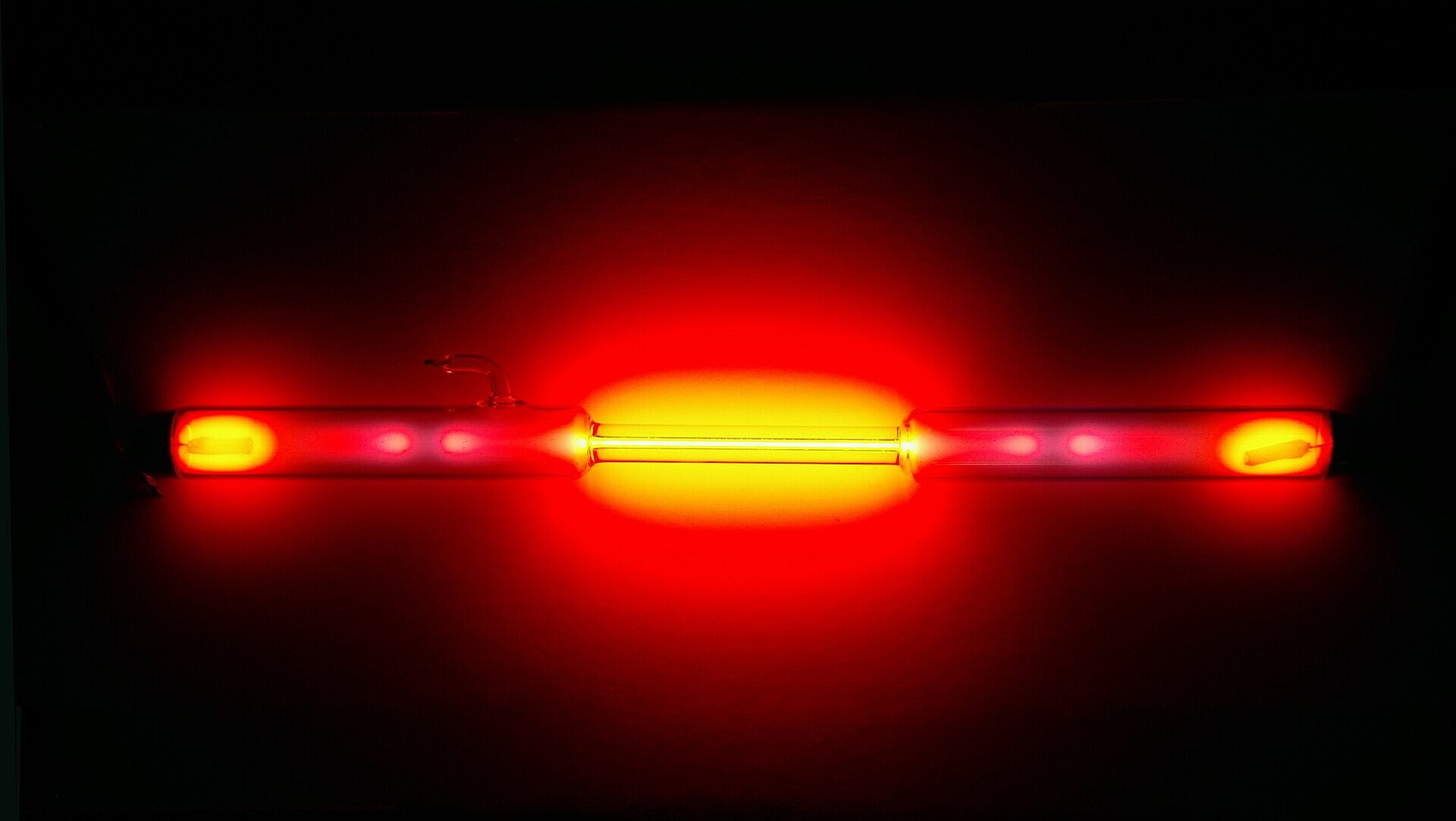
Discovered in 1898 by William Ramsay, Neon (Ne) is the tenth element in the periodic table and a member of the noble gases. It’s a colorless, odorless, and chemically inert gas that glows with a brilliant red-orange hue when electrified—making it a favorite for signage and lighting.
Neon was isolated as one of the last remaining rare gases in dry air, after removing nitrogen, oxygen, argon, and carbon dioxide. Its name comes from the Greek word νέον, meaning “new.” Despite its vibrant glow in discharge tubes, Neon itself is invisible under standard conditions and has no known stable compounds outside of ionic or van der Waals-bound molecules.
Properties
| Property | Value |
|---|---|
| Symbol | Ne |
| Atomic Number | 10 |
| Atomic Mass | 20.1797 u |
| Group | Noble Gases |
| Block | p-block |
| Phase at STP | Gas |
| Appearance | Colorless |
| Density | 0.0009002 g/cm³ |
| Melting Point | −248.59 °C |
| Boiling Point | −246.046 °C |
| Electron Configuration | 2s² 2p⁶ |
| Ionization Energy (1st) | 21.5646 eV |
| Magnetic Type | Diamagnetic |
| Crystal Structure | Face-centered cubic (fcc) |
| Debye Temperature | 70–75 K |
Isotopes
Neon has several isotopes, with Ne-20, Ne-21, and Ne-22 being stable. Others are radioactive with extremely short half-lives:
| Isotope | Mass (u) | Half-life | Decay |
|---|---|---|---|
| Ne-15 | 15.043 | 7.7×10⁻²² s | 2p |
| Ne-17 | 17.018 | 109.2 ms | β⁺ |
| Ne-19 | 19.002 | 17.274 s | β⁺ |
| Ne-23 | 22.994 | 37.14 s | β⁻ |
| Ne-30 | 30.025 | 7.22 ms | β⁻ |
| Ne-34 | 34.057 | 1 ms | β⁻ |
Fun Fact
Neon signs don’t always use neon! Only the classic red-orange glow comes from pure neon gas. Other colors are produced using different gases or phosphor coatings.
Dive Deeper
Get Atomic – Periodic Table for all data!
Windows: https://apps.microsoft.com/detail/9nbt1tcw2cnt
Android: https://play.google.com/store/apps/details?id=com.jlindemann.science